Energy and RMSE
Amplitudes vary with time and we may wish to know the mean value of such amplitudes over some particular time interval. When we do this we say we are measuring the Energy (or strength) of the signal.
Two common measures for the Energy are just the 'raw' energy, or the root mean squared energy, or RMSE.
Commonly, like many feature extraction processes in music, we wish to know the energy not for the entire signal, but for small segments of the signal, in order to capture the feature value at a particular point in time. To get the total energy, we sum over the squared values of all time points in a given window.
With RMSE, we have an averaging, where we account for the number of values being summed by including a $\frac{1}{N}$ normalization factor prior to taking the square root. (I.e., we calculate the mean of the squared values).
The energy of a discrete time signal corresponds to the total magntiude of the signal. This roughly corresponds to how loud a signal is. The energy in a signal is defined as
$$ \sum_n \left| x(n) \right|^2 $$
The root-mean-square energy (RMSE) in a signal is defined as
$$ \sqrt{ \frac{1}{N} \sum_n \left| x(n) \right|^2 } $$
Notice that we could also calculate the energy after we have transformed to spectral energy. That is, the energy of a given time frame must be spread in some way across the frequency band (this is what we are measuring when we are measuring the magnitude spectrum). As such, if we simply summed over all the bands, we would know the total magnitude for that time frame.
(Thus, if you are already calculating other spectral features via a STFT procedure, you may wish to compute the energy or RMSE that way. However, for today, we will calculate energy directly from the discrete time signal.
Let's load a signal:
        import numpy as np
        import scipy
        from scipy.io.wavfile import read
        import matplotlib.pyplot as plt
        from IPython.display import Audio
        import librosa, librosa.display
        plt.rcParams['figure.figsize'] = (14, 5)

        #x, sr = librosa.load('../audio/CongaGroove-mono.wav')
        (fs, x) = read('../audio/CongaGroove-mono.wav')
        fs
44100
x.shape
(192425,)
        #make duration array
        dur = x.size/fs
        dur = np.arange(0, dur, 1/fs)
        #normalize amplitude
        xnorm = x/np.abs(x.max())
Listen to the signal:
Audio(x, rate=fs)
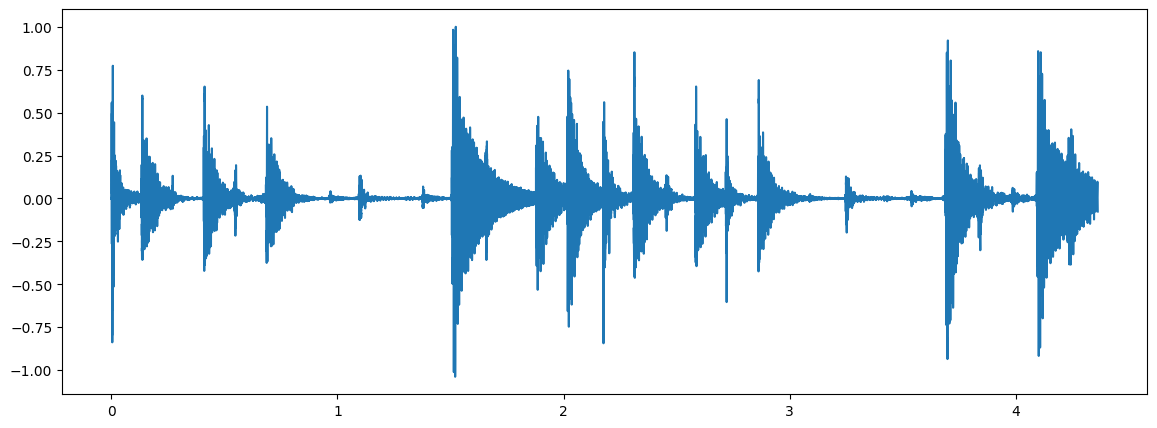
Plot the signal:
plt.plot(dur, xnorm)
Let's compute both Energy and RMSE for sliding windows of 1024 samples.
Notice that we do not have to choose a power of 2 anymore. However, when calculating multiple features (including spectral ones, where you will use power of 2) it is wise to examine the same slice (or collection) of samples.
        hop_length = 512 # 50% overlap
        frame_length = 1024

        energy = np.array([
        sum(abs(xnorm[i:i+frame_length]**2))
        for i in range(0, len(xnorm), hop_length)
        ])

        energy.shape
(376,)
energy[0]
71.35002392164817
Compute the RMS using librosa.feature.rms:
        rmse = librosa.feature.rms(xnorm, frame_length=frame_length, hop_length=hop_length, center=True)
        rmse.shape
(1, 376)
Plot both the energy and RMSE along with the waveform:
        frames = range(len(energy))
        t = librosa.frames_to_time(frames, sr=fs, hop_length=hop_length)

        librosa.display.waveshow(xnorm, sr=fs, alpha=0.4)
        plt.plot(t, energy/energy.max(), 'r--')       # normalized for visualization
        plt.plot(t, rmse[0]/rmse[0].max(), color='g') # normalized for visualization
        plt.legend(('Energy', 'RMSE'))
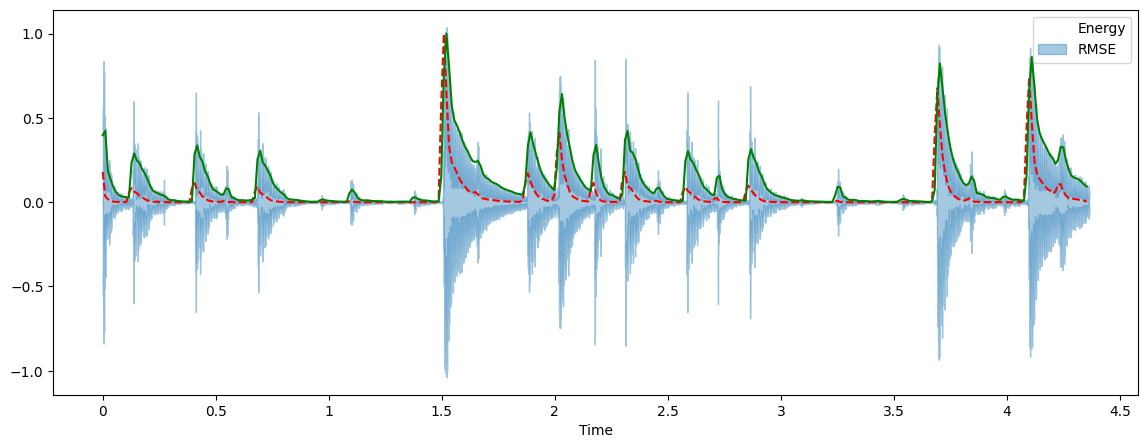
Notice that what we have done with the RMSE is plot the envelope of the signal!
Some Definitions
Attack: sharp increase of energy
Transient: a short duration with high amplitude within which signal evolves quickly
Onset: single instant marking the beginning of transient. (Onsets frequently occur on beats.)
We have primarily until now been looking at pitch-related analysis tasks. Let us know consider *rhythm-related* analysis tasks. Here are a few:
- Onset detection
- Beat detection / beat tracking
- Tempo estimation
Onset detection with Energy
One approach to onset detection is via the following procedure:
- Compute Energy (or RMSE) (optional: convert to log scale)
- Compute Derivative (differentiation) $\Delta E(n) = E(n+1) - E(n) $
- Perform half wave rectification (above or equal to zero; only energy increases are relevant for note onsets).
- Use a thresholding procedure where energy above some cutoff equals "1" (on) to identify onsets.
Notes:
- log energy often better than linear energy
- Works best on tracks with percussion (true really of all onset detection methods!)
Onset detection with Spectrum
An alternative approach uses spectral flux. Recall that spectral flux attempts to capture fast changing properties of the spectral content of the signal. Thus transients are well-captured with spectral flux.
- Compute STFT (optional: convert to log scale)
- Calculate spectral flux
- Use thresholding procedure same as above.
Notes:
- less efficient & more complicated calculations (must sum over all frequency bins & use FFT)
- in some cases you may intentionally want to only sum over certain frequency bands (e.g., noise-like transient power will show up well above 1-2kHz)
- works slightly better for less percussive tracks with soft transients (e.g., legato notes, woodwinds, etc.)
Tempo Estimation
How to estimate the tempo of a clip of music? We assume that onsets occur most frequently on beats, and beats are articulated more strongly and more frequently than off-beats, and should be approximately evenly spaced in time. (We also assume that the tempo is not changing for the purpose of this class!!)
Given this assumption, we need to examine the regularity or periodicity of the onsets. More on that next lecture!