A simple effect: Delay
Implementing delay
The simplest delay function will create a copy of the input, add some silence to the beginning of the copy, and combine it with the original input.
        import numpy as np
        from scipy.io.wavfile import read
        import matplotlib.pyplot as plt
        #plt.rcParams['figure.figsize'] = (9,4)
        #%config InlineBackend.figure_format = 'svg'
        from IPython.display import Audio

        (fs,x) = read('../audio/AcousticGuitar.wav')
        #Normalize between -1 and 1:
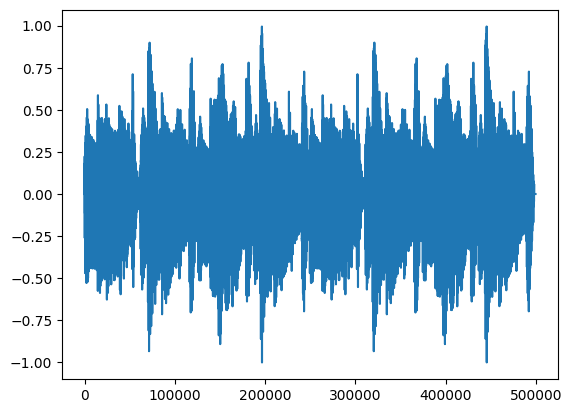
        data = x/abs(x).max()
        plt.plot(data)
copy = data.copy()
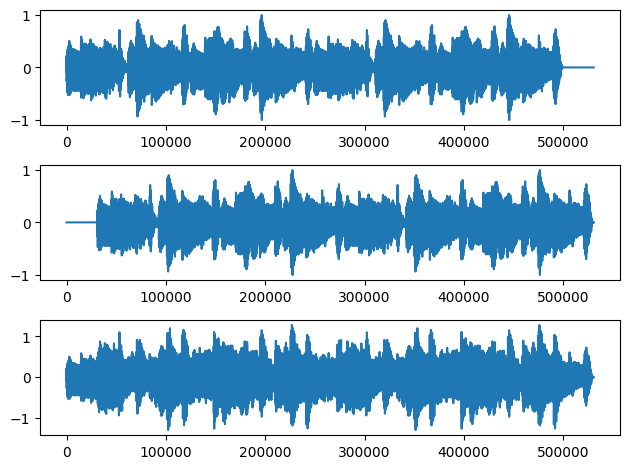
Let's zero-pad the original signal and the copied signal so they have the same length
                    #time in ms to delay by
                    offset = 700
                    #create number of samples equal to 700ms under the given sampling rate
                    pad = np.zeros(int(fs/1000*offset))
                    orig = np.concatenate([data,pad])
                    delay = np.concatenate([pad,copy])
                    new_s = orig+delay
                    plt.subplot(3,1,1)
                    plt.plot(orig)
                    plt.subplot(3,1,2)
                    plt.plot(delay)
                    plt.subplot(3,1,3)
                    plt.plot(new_s)
                    plt.tight_layout()
Audio(orig, rate=fs)
Audio(new_s, rate=fs)
To make this sound more like a realistic echo, we can change the volume of the delayed audio by scaling the amplitude on the delay (copy) file.
            delay2 = delay*.5
            new_s2 = orig+delay2
            Audio(new_s2, rate=fs)
        #time in ms to delay by
        offset = 350 # started at 700
        #create number of samples equal to N ms under the given sampling rate
        pad = np.zeros(int(fs/1000*offset))
        orig = np.concatenate([data,pad])
        delay = np.concatenate([pad,copy])
        new_s = orig+delay
        Audio(new_s,rate=fs)
Another enhancement to the delay function is to allow for multiple repeats.
Each time a repeat occurs, we can opt to scale the volume of each repeat (or not).
Let's try 3 repeats each with a 1000ms delay:
        #First delay
        #time in ms to delay by
        offset = 1000
        #create silence equal to number of samples equal to 1000ms under the given sampling rate
        pad = np.zeros(int(fs/1000*offset))
        #orig = np.concatenate([data,pad])
        orig = np.concatenate([copy,pad,pad,pad])
        delay1 = np.concatenate([pad,copy,pad,pad])
        delay2 = np.concatenate([pad,pad,copy,pad])
        delay3 = np.concatenate([pad,pad,pad,copy])
        new_s = orig+(delay1*.5)+(delay2*.25)+(delay3*.125)
        Audio(new_s,rate=fs)
Notice that the process of padding and concatenating can easily be turned into an iterative process...
        iters = []
        repeats = 3
        for i in range(repeats+1):
            offset = 1000
            #create some silence
            pad_beg = np.zeros(int(fs/1000*offset*i))
            pad_end = np.zeros(int(fs/1000*offset*(repeats-i)))
            # add to the original starting from first delay
            delay=np.concatenate([pad_beg,copy,pad_end])
            iters.append(delay)
        newnew_s = np.sum(np.array(iters),axis=0)
Or, better, without any loops:
        import numpy as np
        a = np.arange(10)
        np.roll(a,2)
array([8, 9, 0, 1, 2, 3, 4, 5, 6, 7])
        repeats = 3
        offset = 700
        pad = np.zeros(int(fs/1000*offset))
        delay = np.concatenate([copy, np.tile(pad, 3)])
        delay += np.roll(delay, pad.size)

        Audio(delay, rate=fs)